

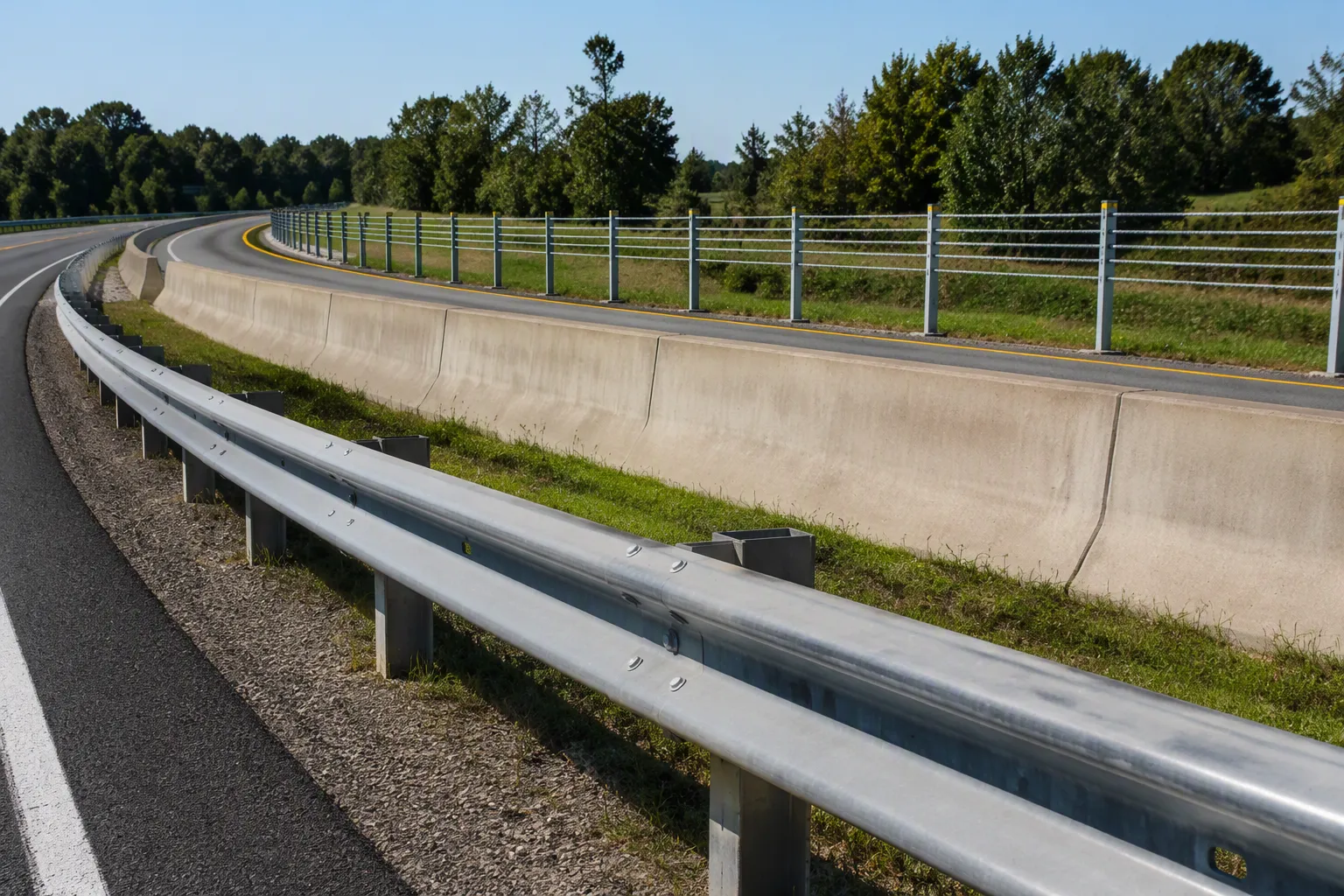
Three main guardrail systems protect highways: W-beam (Flex Beam), Thrie-beam, and cable barriers. Each absorbs impact energy and safely redirects your vehicle. Studies confirm guardrails reduce severe crash risk by up to 50%. Your choice depends on traffic, speed limits, terrain, and budget. ACEG engineers quality systems across these categories, including High-Strength Low Deformation Guardrail.
Guardrails reduce severe crash risk by up to 50%.
W-beam, Thrie-beam, and cable barriers each protect you in different ways.
Choose the right guardrail based on traffic, speed, terrain, and budget.
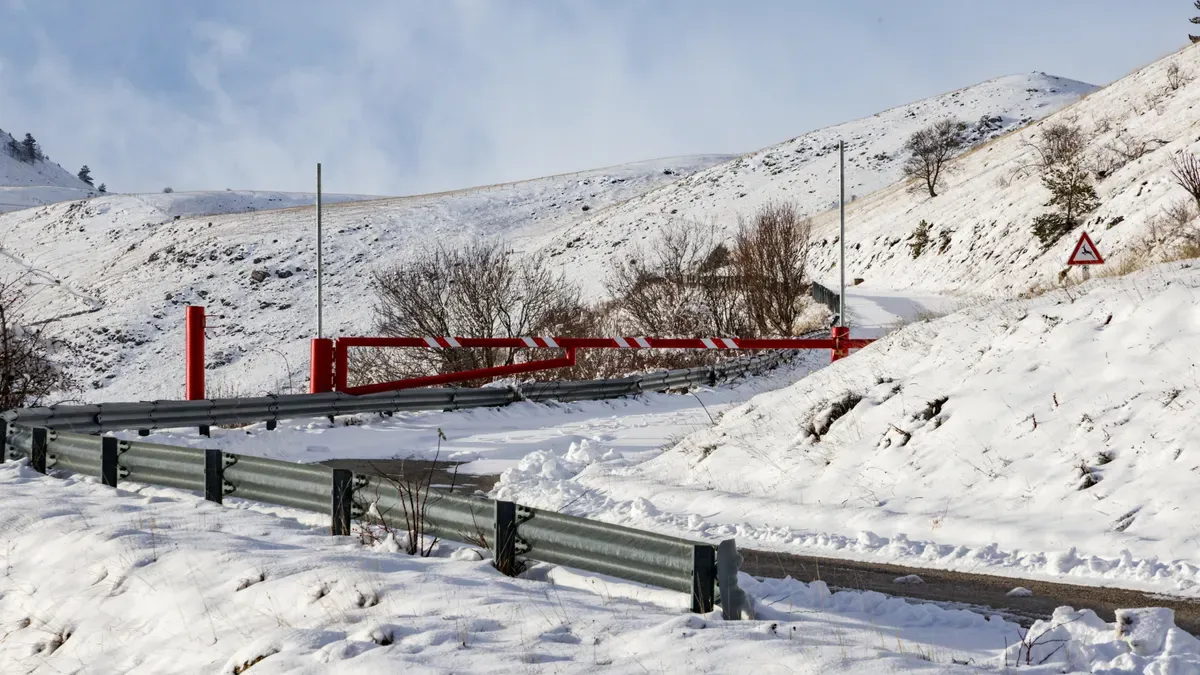
You see W-beam guardrails along most highways. The name comes from the beam's shape. It looks like the letter "W" when you view it from the side. This design absorbs impact energy and redirects your vehicle back onto the road. The NCHRP Report 350 sets the federal standard for evaluating these systems. It recommended using a 2000 kg pick-up truck for testing. Full-scale crash tests confirmed that steel posts with routed wood blockouts meet the NCHRP 350 TL 3 criteria.
Manufacturers build W-beam guardrails from prime steel. Common material options include:
Base material: prime steel meeting quality and chemistry requirements
Finishes: galvanized, black, painted epoxy coatings, or weathered steel
AASHTO M-180 classes: Class A (12 gauge) and Class B (10 gauge)
Zinc coating types: Type 1 (1.8 oz/sq ft), Type 2 (3.6 oz/sq ft), Type 3 (uncoated), Type 4 (weathering steel)
Standard dimensions vary by project needs. The table below shows typical values.
|
Parameter |
Standard Values |
|---|---|
|
Beam Length |
4,320 mm (13 ft 6 in); 4,000 mm; 3,810 mm (12 ft 6 in) |
|
Beam Width |
310 mm to 312 mm |
|
Wave Depth |
80 mm to 85 mm |
|
Flange Width |
~55 mm |
|
Thickness (Gauge) |
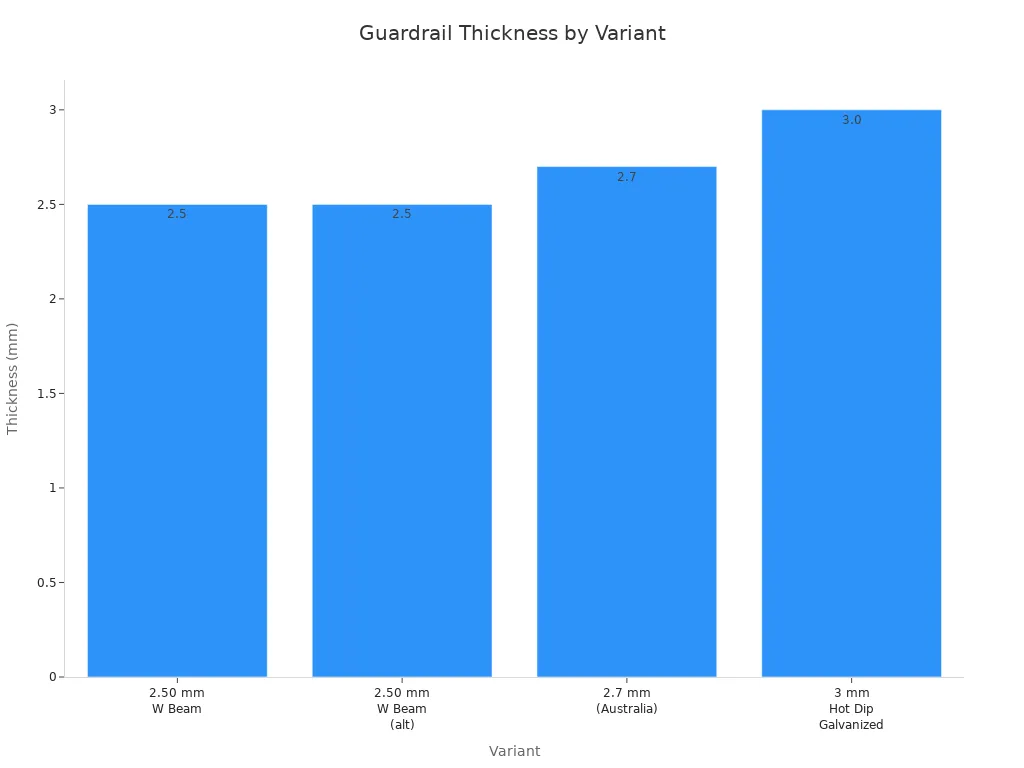
2.67 mm (12 gauge); 2.70 mm; 3.00 mm; 3.43 mm (10 gauge); 4.00 mm (heavy-duty) |
AASHTO guidelines define typical installation locations. The table below summarizes key placement guidance.
|
Typical Location |
AASHTO-Based Guidance |
|---|---|
|
Fill slopes |
The AASHTO Roadside Design Guide provides figures to determine whether a fill slope warrants a barrier. If the ADT and fill height fall on the "Barrier Considered" side of the embankment slope curve, a barrier should be provided when flattening the slope is not feasible or cost-effective. |
|
Cut slopes |
Usually less risky than a traffic barrier, except for rough-faced rock cuts that may snag vehicles. W-beam guardrail is listed as a potential treatment option after individual investigation and cost-effectiveness analysis. |
|
Fixed objects |
Guardrail protection may be necessary for fixed objects such as trees or utility poles. It is warranted in advance of any fixed object within the clear zone if the object is potentially more damaging than the guardrail and cannot be economically removed, relocated, or made crashworthy. |
W-beam guardrails offer clear advantages on high-speed roads. They resist corrosion and harsh conditions because of hot-galvanized steel. Shock absorption testing shows they withstand impacts at speeds up to 100 km/h. They do not require concrete bases, so installation is faster and easier. The design absorbs impact energy and gradually guides your vehicle back into its lane. ACEG manufactures Highway Sound Barrier Systems that meet these demanding standards.
A Thrie-beam guardrail looks like a W-beam with one extra wave. The three-wave cross design adds strength and stiffness. Manufacturers shape it from steel coil and galvanize it to prevent corrosion. You get two steel thickness options: 10-gauge and 12-gauge. This extra wave makes the rail more rigid than a standard W-beam. Engineers often pair the two designs on the same highway segment:
For longitudinal barriers, it is common practice to use a standard W-beam guardrail along the required highway segments and to use a stiffened thrie-beam guardrail in a transition region near the end of a bridge. As a result of the differences in rail geometries, a W-beam–to–thrie-beam transition element is typically used to connect and provide continuity between the two rail sections.
ACEG builds Thrie-beam systems to AASHTO M180-79 or your project requirements. Base steel options include Q235 and Q345. Hot-dip galvanized or powder-coated finishes are available, with a standard galvanization thickness of 70 µm. The table below lists common dimensions.
|
Component |
Standard Size |
|---|---|
|
Rail Length |
4.32 m (14 ft) |
|
Rail Width |
Approximately 510 mm (20 in) |
|
Post Spacing |
1905 mm (same as W-beam) |
Crash testing follows strict criteria. Under MASH Test Level 3, engineers run a 1,100 kg passenger car and a 2,268 kg pickup truck at 100 km/h and a 25-degree angle. Earlier NCHRP Report 350 testing confirmed that a redesigned W-beam to Thrie-beam transition met TL-3 criteria after researchers raised the rail to the Midwest Guardrail System height of 787 mm (31 in.).
You will find Thrie-beam guardrails in higher-speed areas and locations with greater exposure, such as bridges. They suit high-volume freeways, sharp curves, and sites with a limited clear zone near steep drops or deep water. The stiffer design also contains heavier vehicles. An H2-rated Thrie barrier can stop a 10,000 kg (22,000 lb) vehicle traveling at roughly 90 km/h (56 mph). ACEG supplies Highway Beam Safety Barrier engineered for these demanding, high-impact applications.
Cable barrier systems use tensioned steel cables to absorb impact and prevent vehicles from crossing medians. The United States leads the cable barrier market with around 40% of the global share, valuing it at over $500 million by 2025. For applications requiring minimal deflection, ACEG also produces High-Strength Low Deformation Guardrail.
A cable barrier system includes these key components:
High-tension cables (wire ropes)
Cable splices
Steel support posts
Attachment brackets
Breakaway end terminals
Reinforced concrete foundations
These systems distribute collision forces evenly:
Tension cables, shock plates, and internal dampening systems distribute collision forces evenly. This combination provides flexibility without sacrificing strength.
Standard cable barrier specifications include a post spacing of maximum 4 feet and cable tension of about 100 pounds per cable. Systems must meet NCHRP Report 350 tests or MASH 2016. The table below shows relevant MASH test levels.
|
Test Level |
Vehicle Types |
Impact Speed |
|---|---|---|
|
TL-3 |
Cars and trucks |
62 mph |
|
TL-4 |
Cars, trucks, single-unit trucks |
62 mph (cars), 56 mph (trucks) |
|
TL-5 |
Cars, trucks, tractor trailers |
62 mph (cars), 50 mph (trailers) |
You can expect cable barriers to prevent 95% to 97% of vehicles from crossing medians at a cost of $12 to $28 per linear foot.
You should install cable barriers in median lanes on high-volume highways. For medians 30 feet or less with over 20,000 vehicles per day, median barrier installation is recommended. Studies show a 63% reduction in cross-median fatalities after installation.
You can use a High-Strength Low Deformation Guardrail to minimize rail deflection during impact. This system maintains a W-beam profile with plate thickness from 2.5 mm to 4.0 mm and post spacing of approximately 1.9 meters. The double-sided zinc coating exceeding 550 g/m² ensures corrosion resistance. This High-Strength Low Deformation Guardrail meets TL-3 and NCHRP 350 requirements. ACEG engineers this High-Strength Low Deformation Guardrail for bridge approaches and narrow medians where limited space requires minimal deflection.
W-beam, Thrie-beam, and cable barriers all bend and absorb energy on impact. Rigid barriers, such as concrete Jersey barriers, and semi-rigid options offer different deflection levels. Your highway conditions and safety goals determine the right choice. ACEG delivers reliable guardrail solutions across multiple categories, including High-Strength Low Deformation Guardrail, backed by quality manufacturing and engineering support.
Guardrail run out distances and length of need requirements, as recommended in the RDG, are dependent on traffic conditions, guardrail layout, and the characteristics of the hazard to be shielded.
W-beam and Thrie-beam systems perform well on high-speed roads. ACEG engineers both types to absorb impact and redirect your vehicle safely.
You choose cable barriers for wide medians with high traffic volume. W-beam guardrails suit roadside hazards and narrower clear zones.
Yes. ACEG manufactures guardrails to your project requirements, including custom dimensions, coatings, and steel grades for specific highway conditions.

leave a message
Scan to Wechat/Whatsapp: